What to expect when trekking to Everest Base Camp
EVEREST BASE CAMP ⚡️ LIMITED SPOTS LEFT ⚡️ BOOK IT ⚡️ ANNAPURNA BASE CAMP ⚡️ LIMITED SPOTS LEFT ⚡️ BOOK IT ⚡️
EVEREST BASE CAMP ⚡️ LIMITED SPOTS LEFT ⚡️ BOOK IT ⚡️ ANNAPURNA BASE CAMP ⚡️ LIMITED SPOTS LEFT ⚡️ BOOK IT ⚡️
Are you planning to trek to Everest Base Camp in Nepal?
Then get ready for an unforgettable experience.
The Khumbu Region is steeped in history and culture, has extraordinarily beautiful views, the friendliest people and a range of budgets to suit even the most cost conscious traveller.
In this blog I’ll share with you what it’s like alongside the trail to Everest Base Camp from the hilarious encounters with mule and yak trains to visiting iconic landmarks like the Hillary Suspension Bridge and Tengboche Monastery, and to observing life beside the trail all the while learning what it is to be a Sherpa.
Trekking to Everest Base Camp had been on my bucket list for several decades, it’s one of the world’s iconic hikes and one that many people, including non hikers are familiar with.
When Andrew and I shared that we were going to Nepal, everyone knew immediately where we were headed and what we’d be doing and they couldn’t wait to see the videos.
Nepal with it’s Himalayan Mountain Range, lays claim to eight of the ten highest peaks in the world and when trekking to Everest Base Camp, you’ll see some of them yourself including of course Mount Everest.
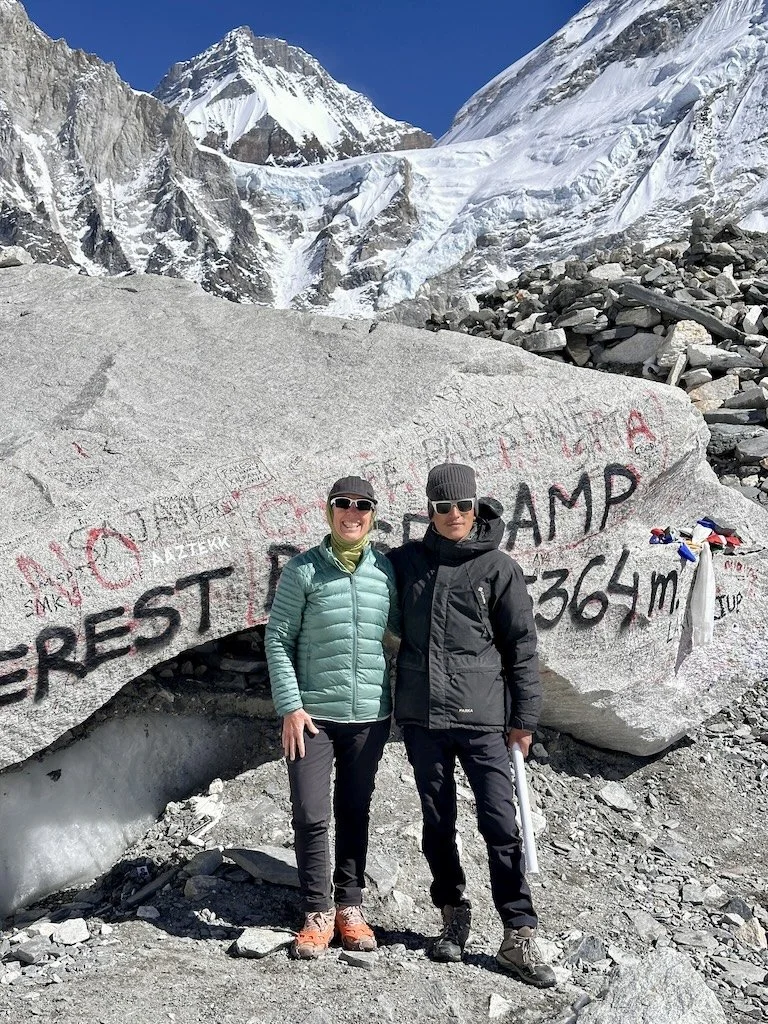
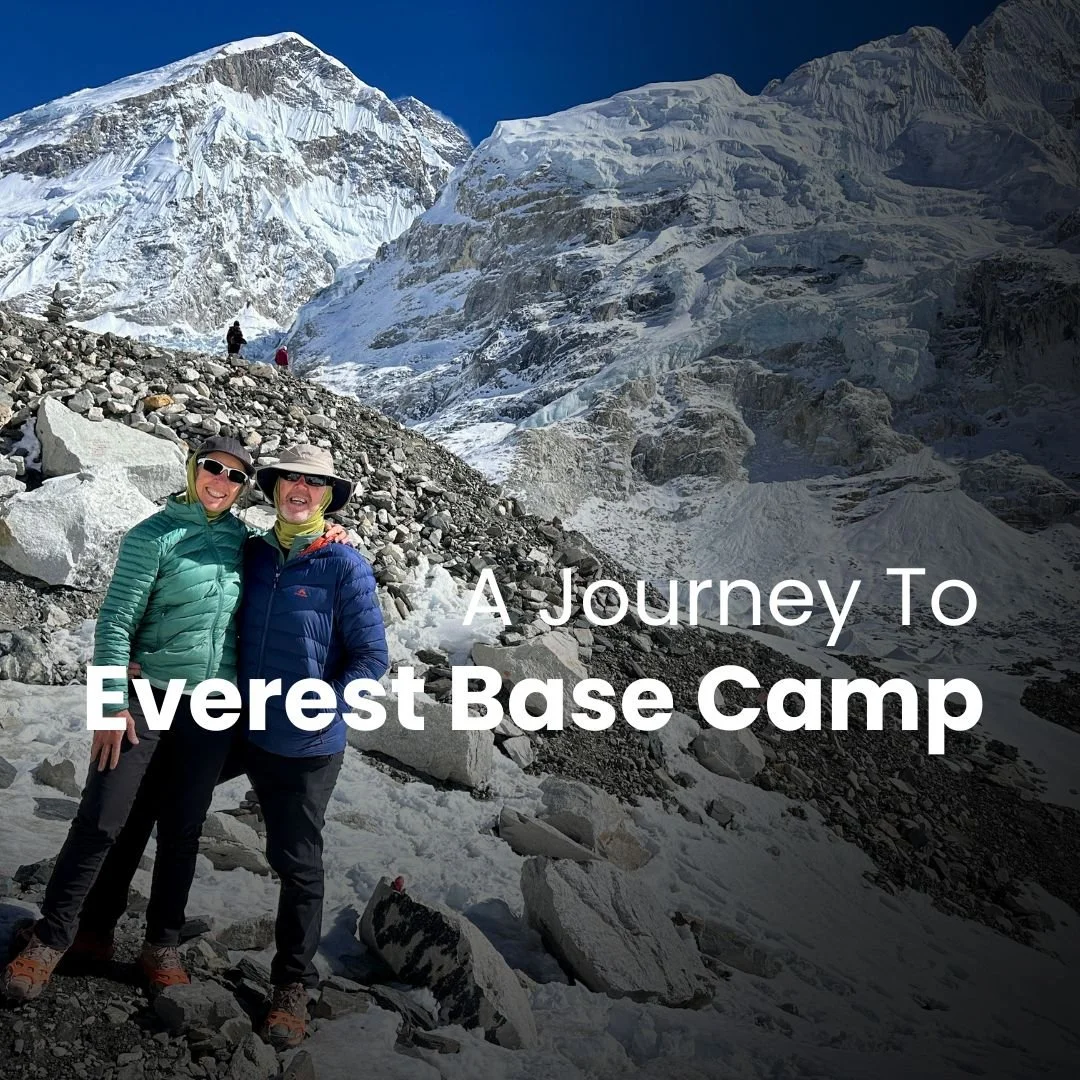
Standing alongside the Khumbu Glacier and gazing up at peaks that are well over eight thousand metres high is an extraordinary feeling, one that was for me, quite emotional.
Grab yourself a hot drink and settle in for the story.
Topics covered in this blog:

Mount Ama Dablam, Dingboche, Sagarmatha National Park
Introduction to Guided Tours
The night before our group left Kathmandu, we met our guide, Raju Simkhada, who had just that day returned from another trek. This was to be my first experience with a guided tour and I was very interested to see the difference it made compared to hiking independently of which I’ve completed thousands of kilometres carrying all my own gear and sorting the logistics as I went.
Raju briefed us on what was to come; the next day’s flight to Lukla where we’d meet our three porters, the start of the trail and going through the police checkpoints before entering the Sagarmatha National Park and the breathtaking mountain vistas that lay ahead of us.
Upstairs in our hotel room, Andrew and I packed and re packed all our gear into the provided duffle bags. We’d be leaving our own backpacks at the hotel with all the clothes and personal effects not needed for this trek and there was a lot of swapping back and forth till we felt confident we’d narrowed it down to the essentials.
Already the benefits of having a guide and porters were clear and I loved not having to think about the logistics, happy to hand over all responsibility to someone else so I could relax and focus on enjoying the beauty of the trail.
Setting the alarm for a very early start we went to bed with nervous anticipation about what the coming days would reveal.

Andrew, Himalayan Recreation Guide - Raju Simkhada and Sharon
Altitude
Fresh from hiking Te Araroa, New Zealand’s three thousand kilometre trail, I was confident in my ability to complete the Everest Base Camp trek which is a comparatively short distance of around one hundred and thirty kilometres.
Our tour manager, Bishnu Thapa, had planned that we spread the trek over thirteen days and with porters carrying our duffle bags, I didn’t anticipate any fitness challenges though I was very mindful of the effect that the high altitude could potentially have.
Altitude sickness can impact anyone, no matter your fitness or prior high altitude experience. Before this trek, the highest altitude I’d reached was summiting Mount Kinabalu in Borneo which is a little under four thousand, one hundred metres whereas Everest Base Camp is nearly five thousand, four hundred metres above sea level.
In my usual way, I figured there was no point worrying, I’d either make it or I wouldn’t and with either result, I was determined to enjoy every minute of the experience.
We learnt that carrying as little weight as possible helps to combat the effects and Raju reminded us daily to limit what we carried in our day packs, while loading up our duffle bags for the porters to carry.

My tiny day pack, Phakding, Sagarmatha National Park, Everest Base Camp Trek
Luggage Restrictions
Lukla is the trail head and the flight there caps trekkers total bag weight as each passenger is permitted only fifteen kilograms in total, providing for around ten kilos in the duffle bag, and five in the day bag.
The weight limit is for safety purposes and if your bag is too heavy, it may be removed to come hopefully on a later flight.
Bag weight aside, flying to Lukla is a highlight of the trip, the views are stunning and landing at one of the world’s highest and most remote runways is something you’ll remember forever.
The porters each carry two hiker’s duffle bags plus their own bag so that’s likely to be more than twenty kilos. Having always carried my own backpack, handing my bag over to someone else to carry was an adjustment however as the air got thinner and the track steeper, I was very thankful that all I had was my day pack.
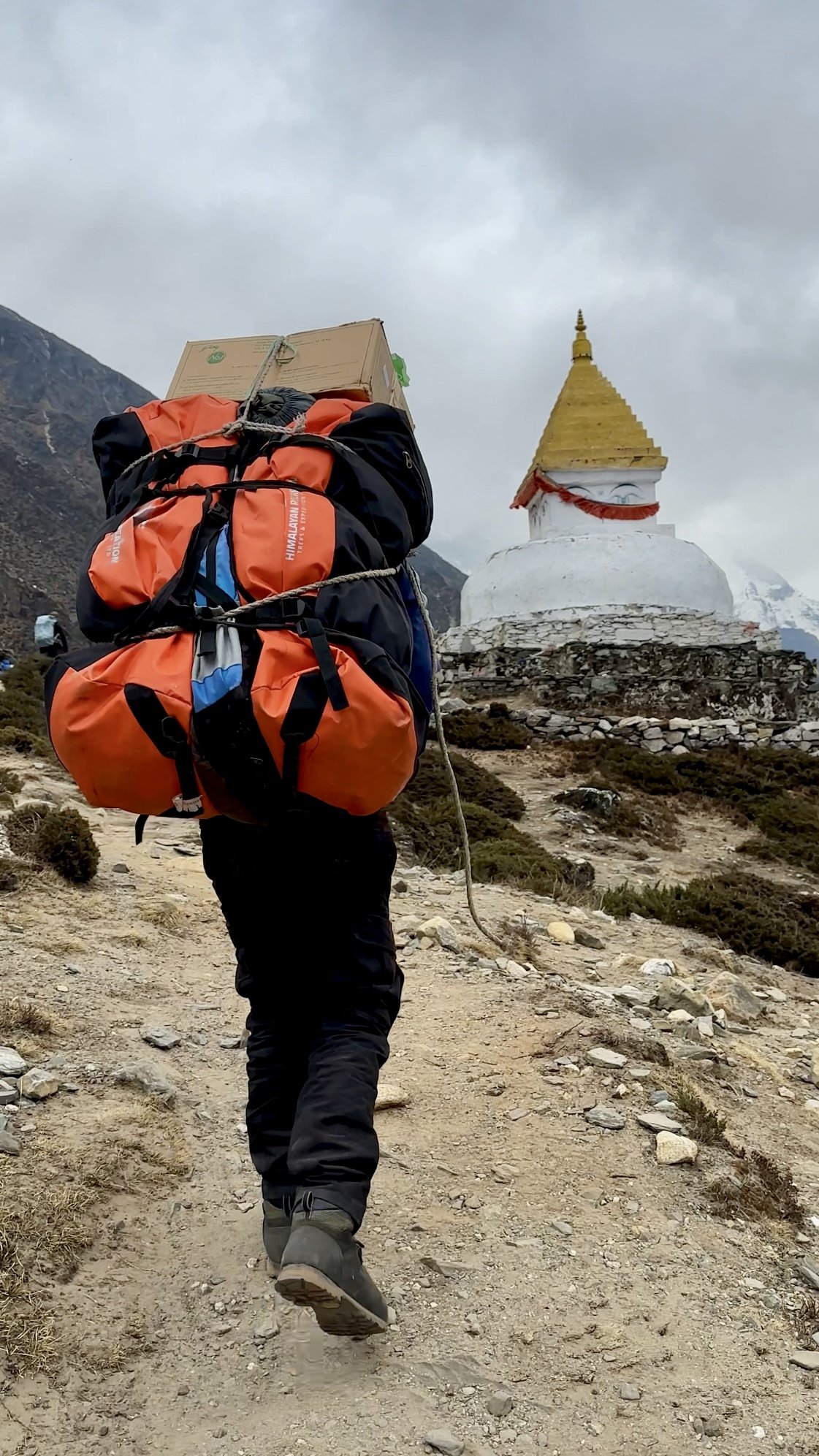
Bhakta Tamang, Himalayan Recreation Porter with duffle bags, Everest Base Camp
Tour Inclusions
Our tour included all the essentials being return ground and air travel from Kathmandu to Lukla, accommodation in Kathmandu before and after the trek plus accommodation at the Tea Houses as we hiked the return journey from Lukla to Everest Base Camp.
In addition the tour included the necessary trekking permits, three standard meals a day, and the licensed guides and porters along with their costs such as wages, insurance, equipment, food and accommodation.
The few items that were not included in our tour package and that Andrew and I enjoyed during our trek included charging our power banks and wifi which needed to be purchased after Namche Bazaar and the bliss of a hot showers at the accommodation when available.
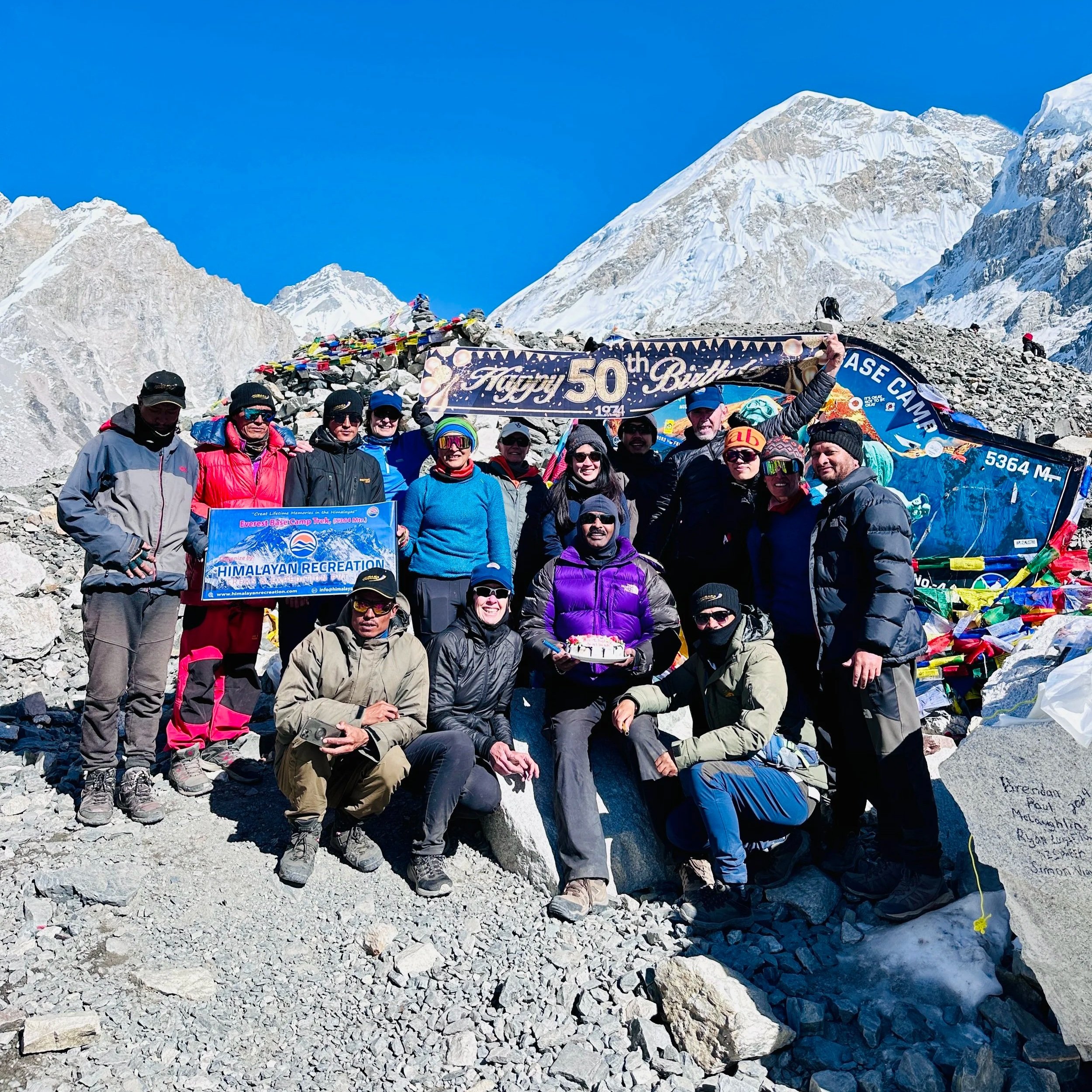
We also treated ourselves to chocolate cake at a couple of bakeries and a celebratory Mars Bar the day we reached Everest Base Camp.

Enjoying chocolate cake at a Namche Bazaar Bakery
Wifi Connections
As a digital story teller, I consider access to wifi an essential as when I’m on an adventure, I love posting daily videos so that you can see exactly what it’s like where I am and while I’m still there.
This is especially true for my Patrons who follow my personal tracker and I love being able to show the visuals immediately to match my tracker.
There were several days at the highest altitudes that I struggled to upload my quick one minute videos as wifi was limited though it seemed adequate for browsing, checking emails and even making the odd video call back home. If you had to endure those couple of glitchy videos, thanks for your patience, I did upload them again as soon as I was able and the series can be seen over on my YouTube Channel
Compared to more developed countries, Nepal is extremely budget friendly to travel in. It’s largely a cash society, their currency being the Nepal Rupee (NR), and away from the larger centres, cash is easiest though be prepared to be handling great bundles of it.
For example, you’ll need four hundred Nepalese Rupees for that celebratory Mars Bar. Seriously, having just been to Everest Base Camp the opportunity to eat chocolate at over five thousand metres altitude was worth every rupee!
Before leaving Kathmandu to begin the Everest Base Camp Trek, we used ATMs to withdraw cash and in addition visited Money Exchangers.
There’s countless ATM and Money Exchangers available in Thamel which is Kathmandu’s tourist hub. For those of you coming from New Zealand, don’t bring New Zealand Dollars as the Money Exchangers don’t accept it nor did the Banks that I visited.

Nepal Rupees
If you want to bring cash, bring United States, Australian, Euro and Sterling currencies. United States Dollars are accepted at many places but I found it easier to be dealing with rupees, it saved me from doing a three way conversion on the hop.
Debit and credit cards are accepted at a large number of businesses in Kathmandu such as hotels, restaurants and larger shopping centres that cater to tourists.
Once on the trail, you’ll need cash in small denominations and there’s no ATMs or Money Exchangers available after you leave Lukla.
As almost all supplies are carried in by porters or on the yak and mule trains to the hotels, restaurants, shops, schools and homes along the Everest Base Camp trail, the prices do become inflated the further you travel from Lukla.
I’d budgeted around twenty to twenty five New Zealand Dollars per day for personal extras and this averaged out well.
It was the bells that first caught my attention, the path was wide and paved with flagstones worn smooth over many years and by many thousands of footsteps. On either side were shops, their displays spilling out, trekking equipment, souvenir T-shirts, brightly coloured handcrafts and goods of all descriptions. Brightly coloured prayer flags were strung above us.
The first mule appeared suddenly from a narrow side alley, a collar of bells jingling around his neck as he lead the herd onto the main path through Lukla, the main path to Everest Base Camp.
There were eight mules, each with a load strapped to their back, I had stepped closer to the shops, out of their way as they’d work to do, whereas I was only a tourist. I felt the warmth of their bodies and breath as they pushed by. We’d left Lukla Airport just moments before and I was beside myself with excitement.

Mule train in Lukla, Everest Base Camp Trek
I’d learnt in Primary School that New Zealand’s Edmund Hillary and Nepal’s Tenzing Norgay were the first to summit Mount Everest in 1953 and with that knowledge came an early awareness of the Himalayan Range and the then Kingdom of Nepal. To an eight year old, it sounded magical and as a keen reader I looked for more stories.
At the time, books from the Rotorua Public Library helped to flesh out their story and deepen my understanding of the Sherpa culture. As I learnt more I came to appreciate the beauty of the Sagarmatha National Park, a UNESCO World Heritage Site since 1976.
Leaving Lukla, we’d meandered along the Dudh Koshi River Valley, Raju’s words of “slowly, slowly”, along with the mule bells still ringing in our ears. Away from the villages, rhododendron trees bordered the path, now a mix of small stone and fine sand.
Far below, the Dudh Koshi River was an icy glacier blue, cascading over boulders though its busy chatter, from our position high on the hill, merely a murmur.
Unexpectedly, it was hot, very hot, the sun unforgiving on my long sleeved black T-shirt, puffer jackets long since removed, the air still and the heat trapped.
Curiously, our first night at Phakding was at a lower altitude than where we’d started in Lukla which is located at over two thousand, eight hundred metres. As we’d headed north and over the course of our walk, we’d actually descended more than two hundred metres.
While hiking to Everest Base Camp, I’d shared daily vlogs and it was my Mum who observed there weren’t enough superlatives to adequately describe the beauty of my surrounds.
You can watch the daily vlogs here and I’m sure you’ll appreciate her comment.
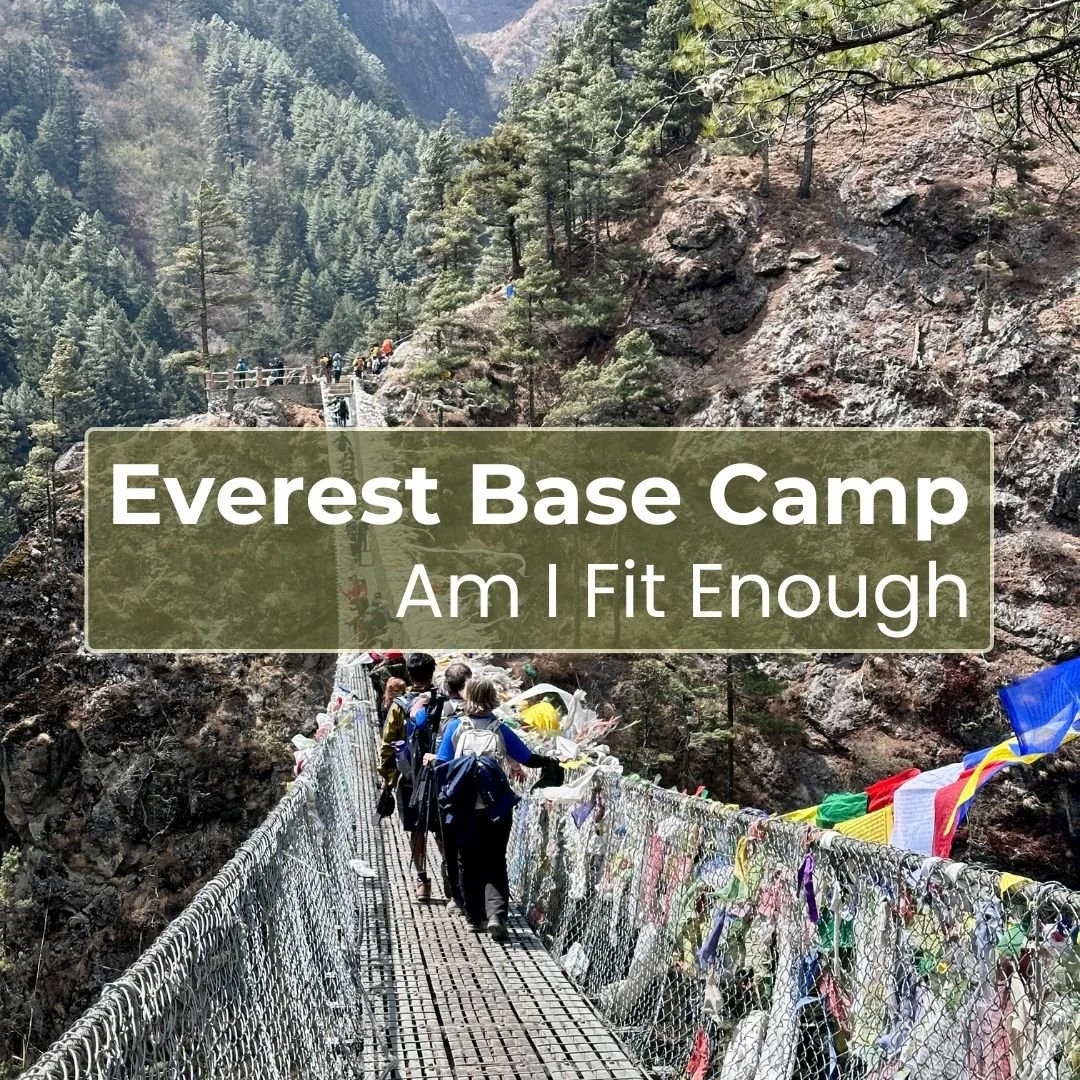
As Raju had instructed, we’d waited patiently while the mules crossed, there wasn’t much choice, fully loaded they took up the width of the Hillary Suspension Bridge.
The Dudh Koshi River raged in the rocky canyon well over a hundred metres below. Enormous boulders balanced ungainly on others, testimony to the River’s enormous strength.
Colourful Buddhist prayer flags whispered their messages of peace, compassion, strength and wisdom in the breeze, spreading goodwill and kindness into the surrounds. Beyond the forested valley the snow capped Himalayan mountains kept a watchful eye.
I’ve written about my own journey to Everest Base Camp from when the seed was sown back in 1990 to finally realising my dream and you can read about it here.

Hillary Suspension Bridge, Everest Base Camp Trek, Sagarmatha National Park
First to step onto the Hillary Bridge were the porters, bowed under the weight of their incredible loads. These weren’t the trekking porters, these were the ones who were carrying all the equipment, the Khumbu Valley’s version of a courier, only without the van.
Despite their huge loads, the porters were faster than us, stepping surefootedly around groups of hikers, yaks and mules and bounding agilely up the hill towards Namche Bazaar.
Sherpa Culture
The Khumbu region was settled about six hundred years ago by Sherpas as they fled their homeland in eastern Tibet.
At lower altitudes, subsistence farming was developed, crops of potatoes, wheat and barley were established and some Sherpas farmed yaks which were ideally suited to the altitudes.
Khumbu is situated at the entry to a major trans-Himalayan trade route that historically linked Nepal, northern India and Tibet and trade remains a vital component of the Sherpas’ adaptation to the harsh environment they live in.
Since the 1970’s, traditional trading of goods and services has now been overtaken by a new source of income, tourism, with the Khumbu Sherpas embracing the new opportunities.
Sagarmatha National Park, which you’ll walk through on your approach to Mount Everest, is a scared landscape to the local Sherpas.
Sagarmatha means “Goddess of the Universe” and is how they reference the world’s tallest peak. The Tibetans, who border the northern side of Mount Everest, call it Chomolungma.
Despite the mountain already being named, in 1856 the British renamed it Everest after the first Surveyor General of India.
However we refer to the Mountain, its a place of magnificence to all.

A Sherpa farmer prepares a crop field, Deboche, Sagarmatha National Park
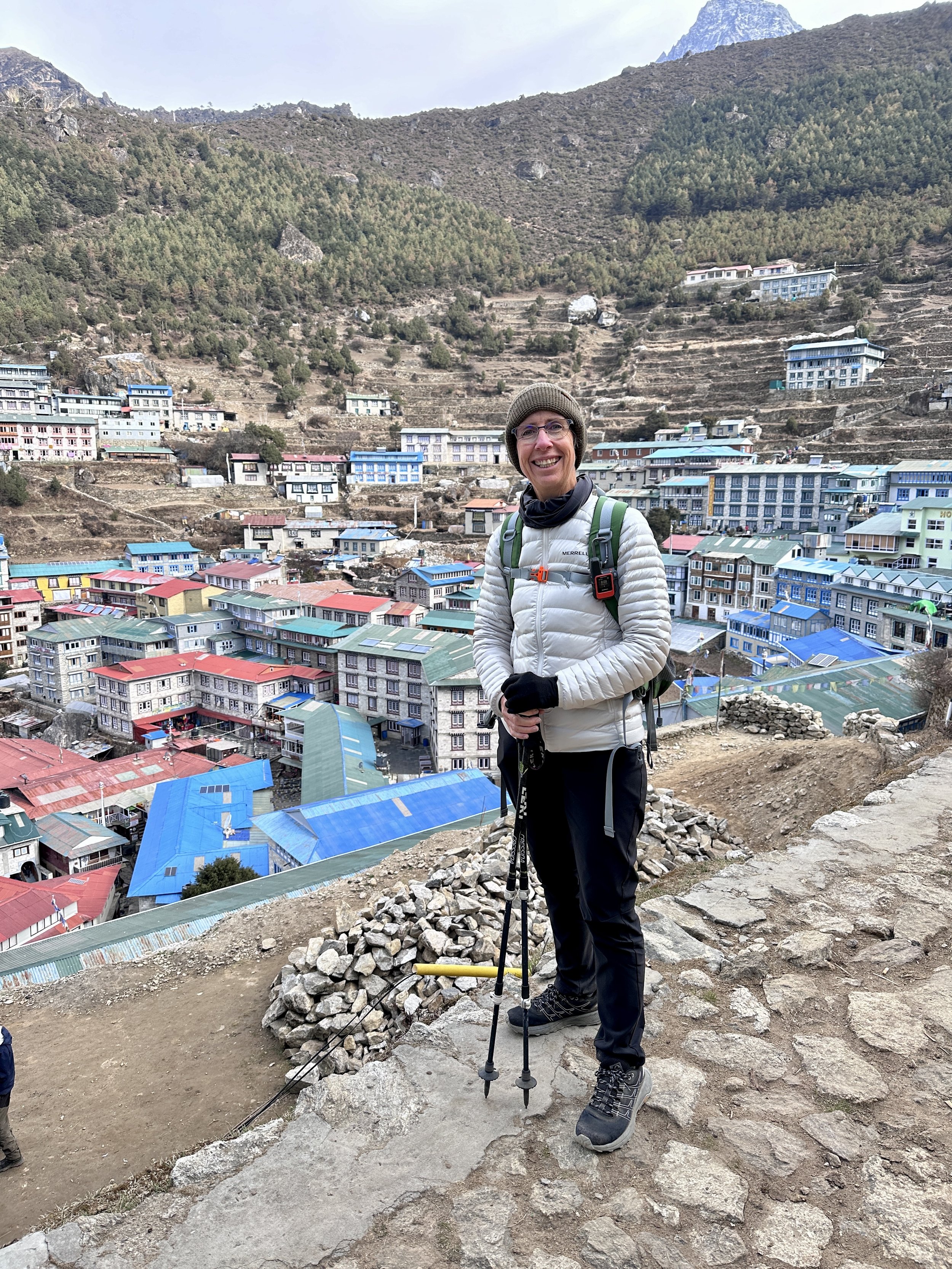
Namche Bazaar, Everest Base Camp Trek, Sagarmatha National Park
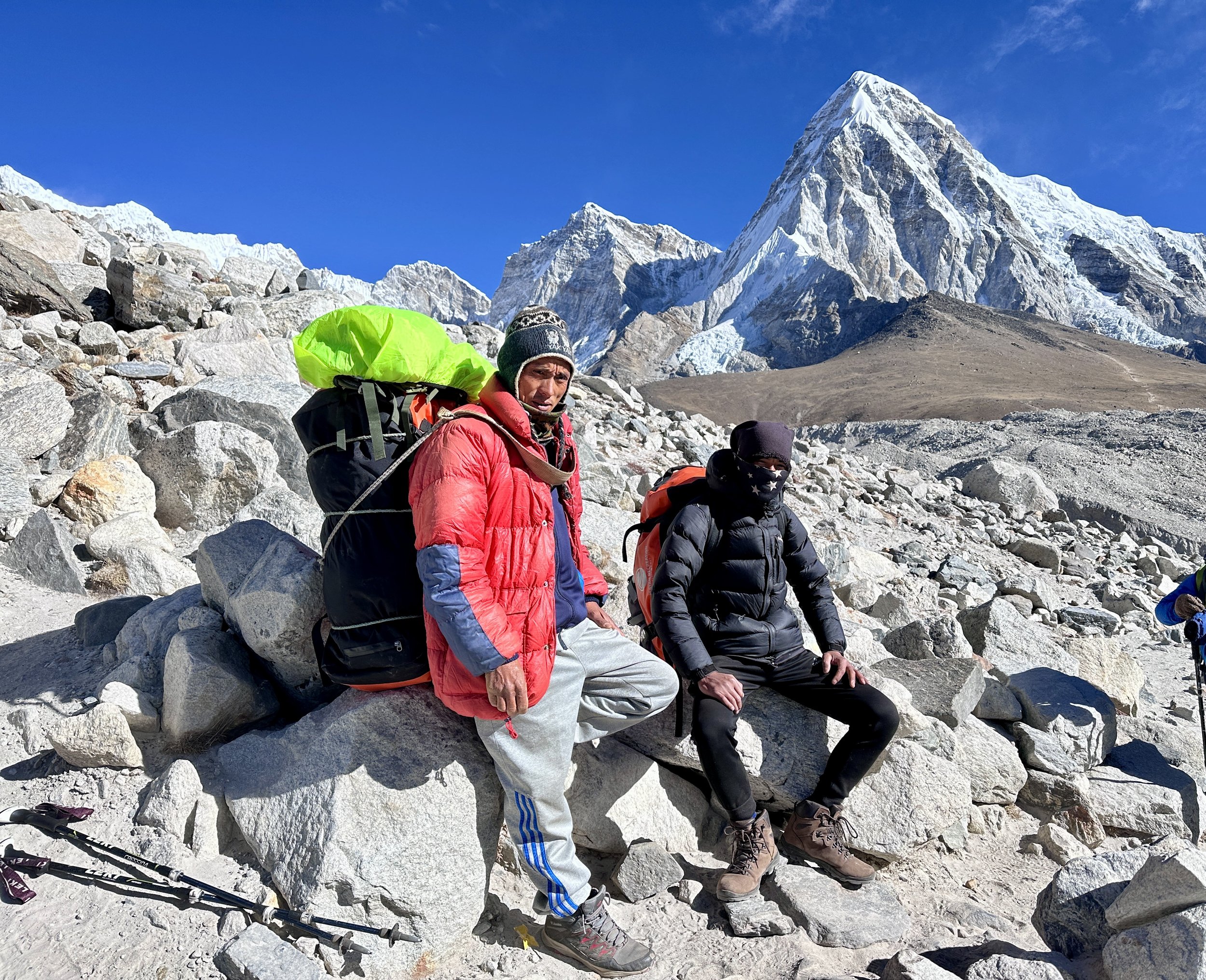
Phurtenji Tamang and Prashant Tamang, Trekking Porters, Gorakshep

Yak, Thado Kashingaor, Sagarmatha National Park
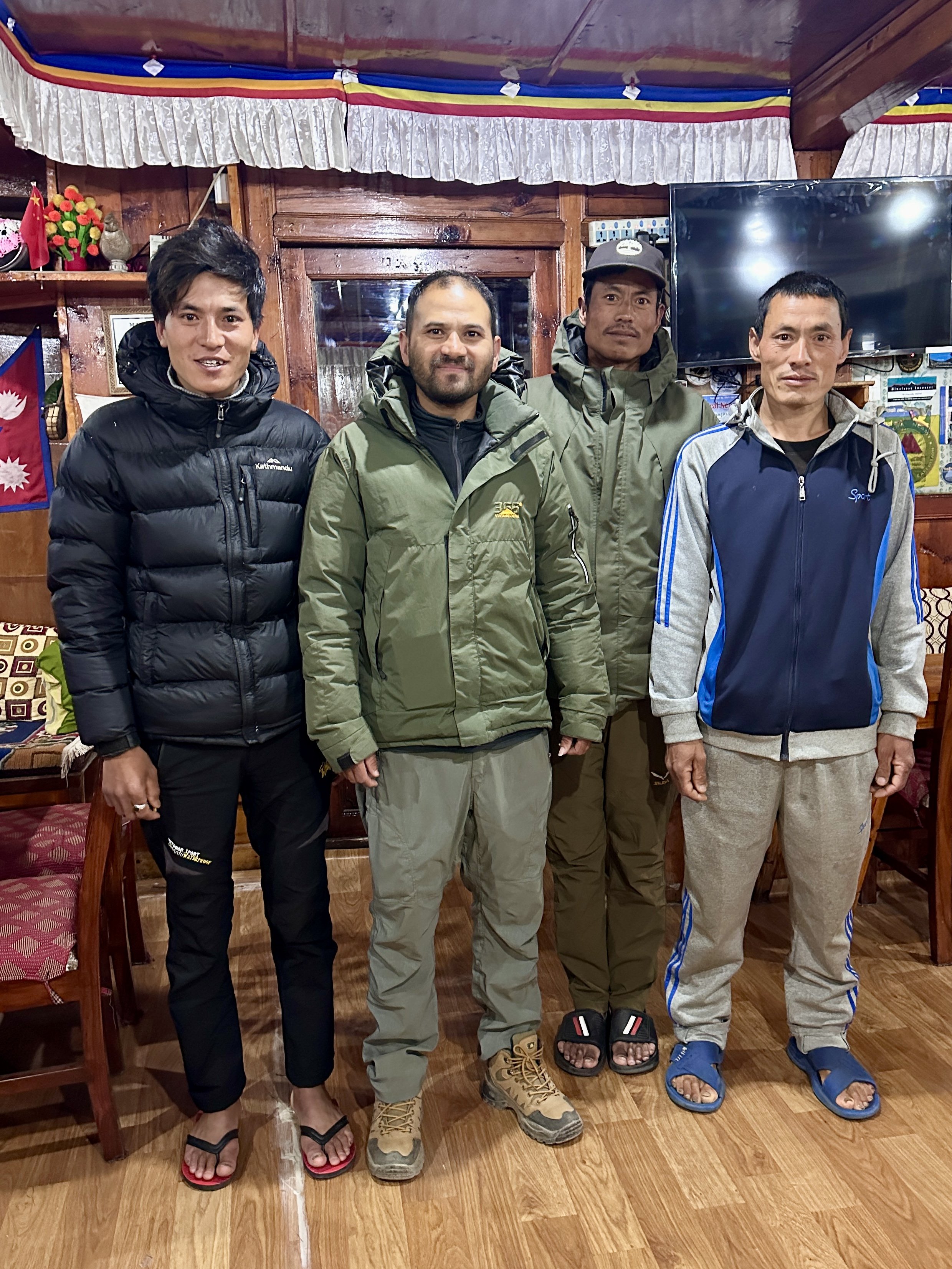
Prashant Tamang, Raju Simkhada, Phurtenji Tamang and Bhakta Tamang, Himalayan Recreation, Lukla, Nepal

Everest Base Camp Group Trip, April 2024, Lukla
We’re headed back to Nepal to join once again with Himalayan Recreation Treks to create lifetime memories. Find out how you can join us HERE


Planning a trip to Nepal
Companies I use while Travelling as a Full Time Travel Content Creator
Himalayan Recreation We travel with Himalayan Recreation when travelling in Nepal, Bhutan and Tibet. Make lifetime memories in the Himalayas on our specially curated Group Trips, a collaboration between Himalayan Recreaton and Freewheeling Kiwi.
Get Your Guide - Unforgettable Travel Experiences - No matter where your travels take you, Get Your Guide offers the best way to connect with your destination. Make memories all over the globe with their locally-vetted, expertly-curated experiences. From must-see iconic attractions to unexpected under-the-radar gems, they have something for everyone.
Expedia - Expedia offers travellers a wide selection of accommodation, flights, package, activities and travel services at attractive rates. With hundreds of thousands of accommodation options worldwide and comprehensive choices of flights inventory made readily available on Expedia.co.nz, travellers can easily plan and book their trip
Skyscanner - Millions of cheap prices. One simple search Compare flight rates from 1000s of airlines and online travel agents to find the cheapest flight tickets to all major destinations. Once you find your best deal, book directly through the airline (no extra fees)
Safety Wing Insurance - Insurance for Nomads Nomad Insurance is a global travel medical insurance that covers people from all over the world, while outside their home country. You can buy it even if you are already abroad.
World Nomads - World Nomads travel insurance has been designed by travellers for travellers. If you leave home without travel insurance or your policy runs out, you can buy or extend while on the road.
We receive a fee when you get a quote from World Nomads using this link. We do not represent World Nomads. This is not a recommendation to buy travel insurance.
Express VPN - Express VPN is the world’s largest provider of VPN services, which enables users to protect their privacy and security online with just a few clicks.
Airalo - E-SIM provider for Data. The World’s First E-SIM Store. Stay connected, wherever you travel, at affordable rates.
Trusted House Sitters - The Freedom to Travel - Discover free and unique homestays around the world, in exchange for caring for adorable pets.
Discover Cars. Save up to 70% by comparing the best car rental deals from 700+ suppliers in 10000+ locations worldwide and FREE Cancellation.
Disclosure: My content is reader-supported, which means I may earn a small commission from links on Freewheeling Kiwi’s Assets if you make a purchase and at no cost to you. This is a way to support me so that I can keep sharing content and stories. Thanks in advance for your support.
Food is always the first thing trekkers stop thinking about and the last thing they should.
At altitude your body is working harder than it ever has, your appetite drops off right when you need fuel most, and the decisions you make at the tea house table matter more than most people realise.
Here's what you need to know before you go.